Private Company vs Sole Proprietor in South Africa: Which Is Better?
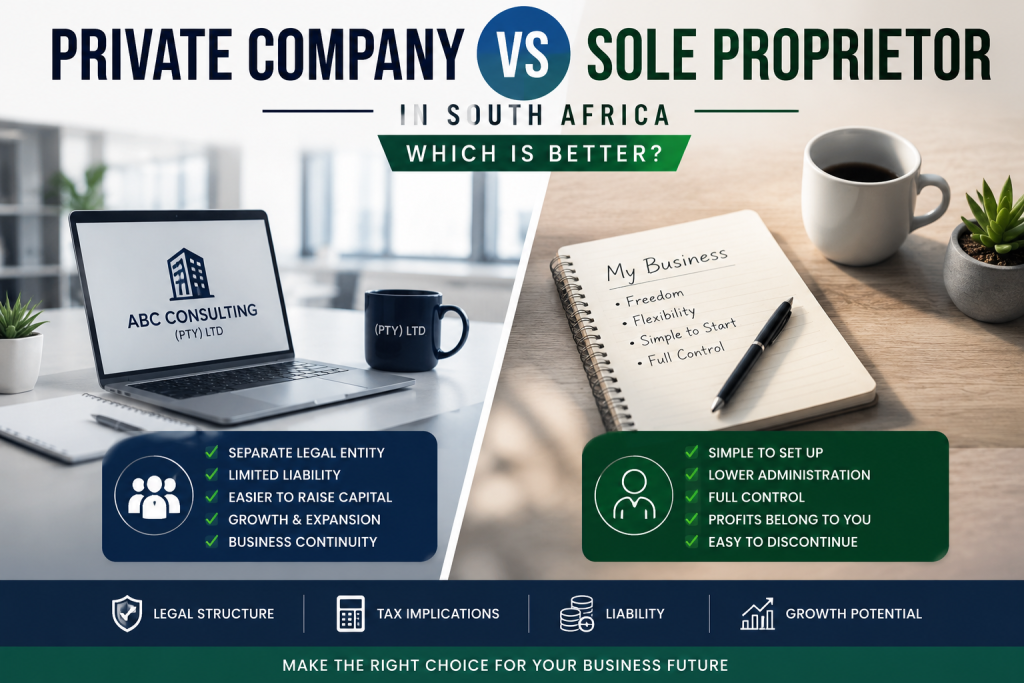
Private Company vs Sole Proprietor in South Africa: Which Is Better? Choosing the right business structure is one of the first decisions you need to make when starting a business in South Africa. For many entrepreneurs, the choice comes down to operating as a sole proprietor or registering a private company (Pty) Ltd. Both options can work well, but they are fundamentally different. A sole proprietorship is not a separate legal entity from its owner, while a private company is a separate legal entity with its own rights and obligations. So, which is better: a private company or a sole proprietor? The answer depends on your business activities, risk, growth plans, administration requirements and financial circumstances. In this guide, we compare a private company vs sole proprietor in South Africa to help you understand the key differences. What Is a Sole Proprietor? A sole proprietorship is one of the simplest ways to operate a business in South Africa. It is owned and operated by an individual, and the business does not exist as a separate legal entity from its owner. This means the owner and the business are legally connected. A sole proprietor can operate under their own name or use a trading name. However, using a trading name does not create a separate legal entity. For example, if Thabo operates a small graphic design business as a sole proprietor, the business remains legally connected to Thabo. The sole proprietor is responsible for the business’s obligations and includes business income in their personal tax affairs. Advantages of a Sole Proprietor A sole proprietorship can be attractive because it is relatively simple to establish and operate. Some advantages include: Simple business structure Fewer formal legal requirements Owner has direct control over decisions Business profits belong to the owner Easy to discontinue Potentially lower administrative burden For someone testing a small business idea or operating a relatively low-risk business, this structure may be suitable. Disadvantages of a Sole Proprietor The biggest consideration is personal liability. Because the sole proprietorship is not a separate legal entity, the owner is responsible for the business’s debts and obligations. SARS explains that the owner’s risk can extend to personal assets, including assets not used in the business. A sole proprietor can also face challenges when trying to raise capital or expand the business because the business depends heavily on the owner’s personal financial resources. What Is a Private Company? A private company is a formal business structure registered with the Companies and Intellectual Property Commission (CIPC). Unlike a sole proprietorship, a private company is a separate legal entity from its owners. The owners of a private company are its shareholders, while the company can have directors responsible for managing it. A private company is commonly identified by (Pty) Ltd after its name. For example: ABC Consulting (Pty) Ltd Because the company is a separate legal entity, it can enter contracts, own assets and incur liabilities in its own name. Advantages of a Private Company There are several reasons why entrepreneurs choose to register a private company. 1. Separate Legal Entity One of the biggest differences between a private company and a sole proprietor is that the company exists separately from its owners. This provides a formal legal structure for the business. 2. Limited Liability Shareholders are generally not personally responsible for the company’s liabilities simply because they own shares. However, limited liability is not absolute. Directors and other individuals can potentially face personal liability in certain circumstances, including specific tax liabilities and situations involving reckless or fraudulent conduct. Therefore, registering a Pty Ltd should not be viewed as a way to eliminate every possible personal risk. 3. Easier Business Expansion A private company can be suitable for businesses that intend to grow, bring in additional shareholders or raise capital. SARS identifies the ability to raise capital and expand as an advantage of the private company structure. 4. Business Continuity A private company can continue operating even when shareholders change. This can provide greater continuity compared with a business that depends entirely on one individual owner. 5. Professional Business Structure For some businesses, operating through a registered company can make it easier to separate personal and business affairs. It can also provide a formal structure when dealing with customers, suppliers, banks and other organisations. Private Company vs Sole Proprietor: Which Is Cheaper? There is no single answer because the overall cost depends on how the business operates and what compliance services it requires. A sole proprietorship generally has fewer formal requirements, which can make it simpler and less expensive to operate. A private company involves additional administration and compliance responsibilities. However, the cheapest structure is not necessarily the best structure. For example, if your business has significant commercial risk, choosing a structure solely because it is cheaper to establish may not be the best long-term decision. It is important to consider both the immediate costs and the potential consequences of the structure you choose. Private Company vs Sole Proprietor: Which Is Better for Tax? Tax is another important consideration. A sole proprietor reports business income through their personal tax affairs. The business itself is not a separate taxpayer from the owner. A private company, on the other hand, is subject to corporate income tax. When a company is registered with CIPC, SARS states that it is automatically registered for corporate income tax through the interface between CIPC and SARS. This does not mean that one structure will automatically result in lower tax for every entrepreneur. Your actual tax position depends on factors such as income, expenses, business structure and which tax provisions you qualify for. Certain qualifying small businesses may also benefit from specific SARS small-business tax measures. For this reason, tax planning should be considered alongside the legal structure of your business. Is a Private Company Better for a Small Business? Not necessarily. A private company can be appropriate for a small business, but being small does not automatically mean you need a Pty
Private Company vs Sole Proprietor in South Africa: Which Is Better? Read More »